A lesser known meteor shower called the Eta Aquarids can be seen during the first week of May each year. The Eta Aquarids usually peak on May 5th and the 6th and produce 15 to 20 meteors per hour in a moonless sky. However, this year the moon will be entering its last quarter during the same time frame and may diminish meteor counts.
An interesting aspect to the Eta Aquarids is that they are caused by debris from Halley's Comet. The next closest approach to Earth by Halley's Comet will be in July 2061, when it will be about 0.48 AU, or about half as much as the distance the Earth is from the Sun. But next week, you will still get to see tiny specks of dust an ice from the famous Halley's Comet as they burn up as they come screaming into the Earth's atmosphere. The debris from Halley's comet does come in a high velocity and these meteors leave bright streaks in the nighttime sky, along with smoke trails.
For the best chance to see any of these meteors, look to the east towards the constellation Aquarius several hours before sunrise. You can start looking starting on the morning of the 4th, until the morning of the 7th. Since this meteor shower has a very broad peak you have the chance of seeing a meteor up to a week or two before or after the peak, which is on May 6th.
If you happen to live in the Southern Hemisphere, you can expect much higher hourly meteor counts, up to 50 per hour.
Showing posts with label comets. Show all posts
Showing posts with label comets. Show all posts
Tuesday, April 27, 2010

Friday, January 9, 2009
Comet Lulin May Become Visible to Naked Eye
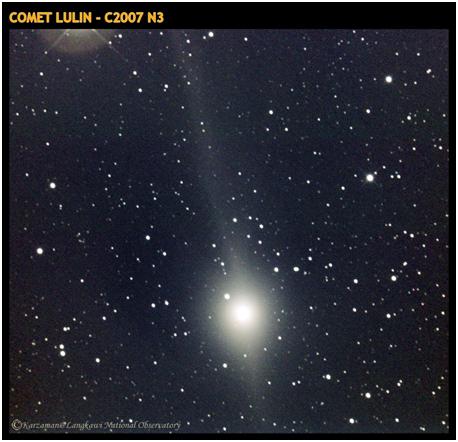 Image: Karzaman Ahmad in Malaysia with a 20-inch scope
Spaceweather.com
Comet C/2007 N2 (aka Lulin) was discovered last year by astronomers working for the Lulin Sky project sky survey. At the time of this post, it is not yet visible to the naked eye. It is still only a Magnitude 11 object. So it will a decent telescope with tracking software and a drive to find.
The comet was discovered last year by the Lulin Sky Survey. This sky survey is a cooperative effort between astronomers from both China and Taiwan. The centerpiece of the program is a 16 inch telescope located at Lulin Observatory at National Central University in Taiwan. The programs goal was to find and track minor bodies in our solar system such as comets and asteroids.
The comet is moving through Scorpio and will make a quick trek across the sky over the coming months. Its closest approach to the Earth will be on February 24th. At that time it should be easily identifiable through binoculars. It may even become visible to the naked eye when it makes its closest pass to earth. Since it is approaching the sun, a tail should also be seen.
An interesting aspect of this comet is that it is orbiting nearly on the ecliptic, but is traveling backwards! Because of this strange orbit, and the comets proximity to the ecliptic, it will appear to have two tails, each pointing in the opposite direction, as seen in the image above which is brought to you courtesy of Spaceweather.com. Karzaman Ahmad in Malaysia captured this image the a 20-inch scope
Thursday, October 16, 2008
Two interesting Comet Discoveries
A pair of comets have found their way into the Meteor Watch Blog today. One discovery is about a comet that was discovered 150 years ago, the other is about a brand new comet.
The first discovery centers around Comet Tuttle. This one was discovered way back in 1858 by American Astronomer Horace Tuttle. It orbits the sun about every 13.6 years. John Harmon and his team at Areicibo Observatory made radar observations of the comet and found that it is actually made up of two separate bodies that are rotating around each other. The separate bodies are small, measuring 4.5 and 5.6 KM across. The two objects rotate around each other about every 11 and a half hours.
Astronomers have long suspected that Tuttle had a rather unusual shape because the Hubble Telescope was able to detect varying degrees of brightness with time. Now they have specific proof that Tuttle is indeed not onle one oddly shaped comet, but it is also two comets in one.
The other discovery was made by an Itallian astronomer named, Andrea Boattini. He found his fifth comet in less than a year. It will be named P/2008 T1, and will also be known as Boattini T1. Boattini has also discovered 170 asteroids in his career, and is noted for find the closest orbiting asteroid to the sun. Quite an accomplishment!
The first discovery centers around Comet Tuttle. This one was discovered way back in 1858 by American Astronomer Horace Tuttle. It orbits the sun about every 13.6 years. John Harmon and his team at Areicibo Observatory made radar observations of the comet and found that it is actually made up of two separate bodies that are rotating around each other. The separate bodies are small, measuring 4.5 and 5.6 KM across. The two objects rotate around each other about every 11 and a half hours.
Astronomers have long suspected that Tuttle had a rather unusual shape because the Hubble Telescope was able to detect varying degrees of brightness with time. Now they have specific proof that Tuttle is indeed not onle one oddly shaped comet, but it is also two comets in one.
The other discovery was made by an Itallian astronomer named, Andrea Boattini. He found his fifth comet in less than a year. It will be named P/2008 T1, and will also be known as Boattini T1. Boattini has also discovered 170 asteroids in his career, and is noted for find the closest orbiting asteroid to the sun. Quite an accomplishment!
Monday, October 13, 2008
Asteroid Search leads to discovery of Comet 2008 T2 Cardinal
A lot of attention has been on asteroid 2008 Tc3 since it had made its entry into the earth's atmosphere over Sudan. This is the first time an asteroid impact was predicted in advance. There are also other objects in the sky that we should all be on the look out for. Comets are far less numerous than the number of asteroids in our solar system, but every once in while a new one is discovered.
Comet 2008 T2 Cardinal was discovered by Rob Cardinal at the University of Calgary. It is currently just above the North Pole and making an approach to the sun. Rob happened to be searching for asteroids as well. The Calgary Herald reports that Rob was looking at some data and the numbers just jumped off the page. Upon further review, he found the comet.
For now, it is too small to see with the naked eye. There is a possibility we will be able to see it without a telescope or binoculars in the April or May time frame. By then, a comet is expected to develop a tail.
Comet 2008 T2 Cardinal was discovered by Rob Cardinal at the University of Calgary. It is currently just above the North Pole and making an approach to the sun. Rob happened to be searching for asteroids as well. The Calgary Herald reports that Rob was looking at some data and the numbers just jumped off the page. Upon further review, he found the comet.
For now, it is too small to see with the naked eye. There is a possibility we will be able to see it without a telescope or binoculars in the April or May time frame. By then, a comet is expected to develop a tail.
Subscribe to:
Posts (Atom)